EMT Practice Test

1. Question Content...


Question List
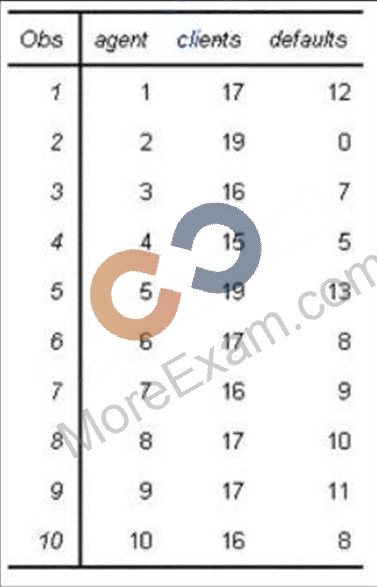
Question1: An analyst fits a logistic regression model to predict whether or not a client will default on a loan. One of
the predictors in the model is agent, and each agent serves 15-20 clients each. The model fails to
converge. The analyst prints the summarized data, showing the number of defaulted loans per agent. See
the partial output below:

What is the most likely reason that the model fails to converge?

Question2: An analyst investigates Region (A, B, or C) as an input variable in a logistic regression model.
The analyst discovers that the probability of purchasing a certain item when Region = A is 1.
What problem does this illustrate?

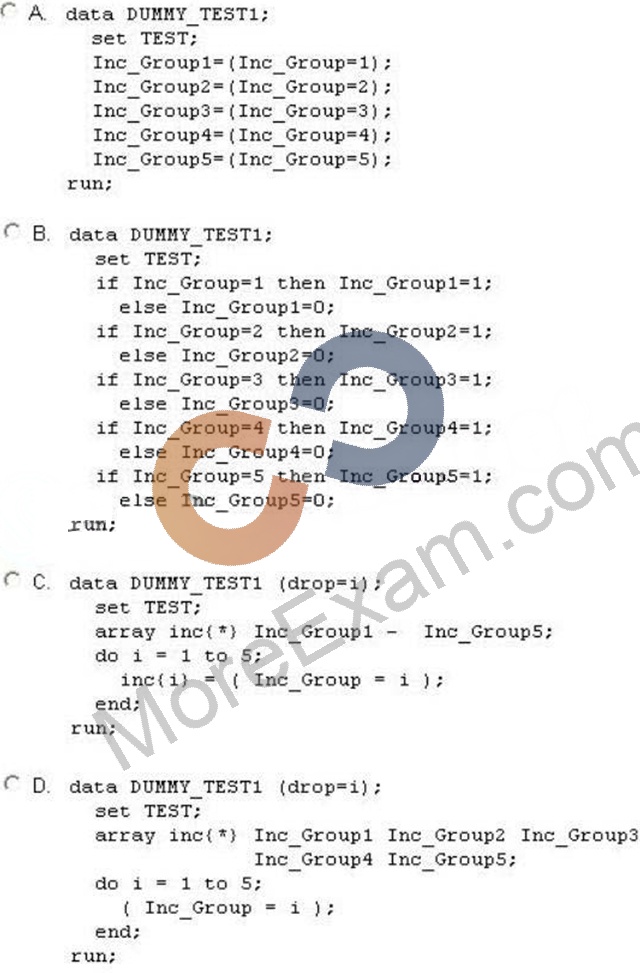
Question3: Given the following SAS data set TEST:

Which SAS program is NOT a correct way to create dummy variables?

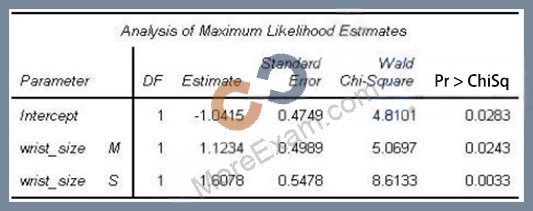
Question4: The following LOGISTIC procedure output analyzes the relationship between a binary response and an
ordinal predictor variable, wrist_size Using reference cell coding, the analyst selects Large (L) as the
reference level.

What is the estimated logit for a person with large wrist size?
Click the calculator button to display a calculator if needed.

Question5: Given the following output from the LOGISTIC procedure:

Which variables, among those that are statistically significant at an alpha of 0.05, have the greatest and
least relative importance on the fitted model?

Question6: An analyst has a sufficient volume of data to perform a 3-way partition of the data into training, validation,
and test sets to perform honest assessment during the model building process.
What is the purpose of the test data set?

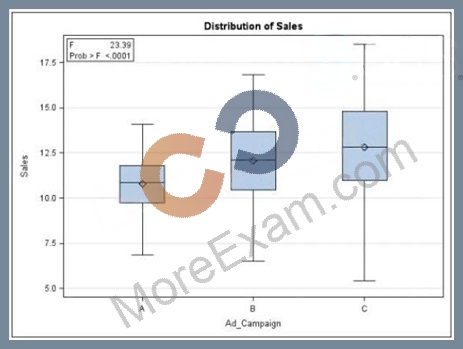
Question7: Refer to the exhibit:

The box plot was used to analyze daily sales data following three different ad campaigns.
The business analyst concludes that one of the assumptions of ANOVA was violated.
Which assumption has been violated and why?

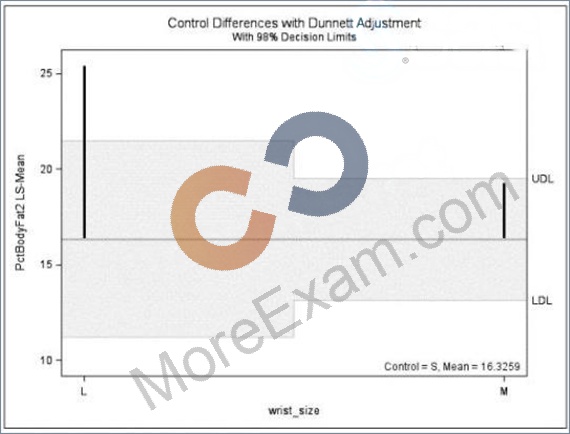
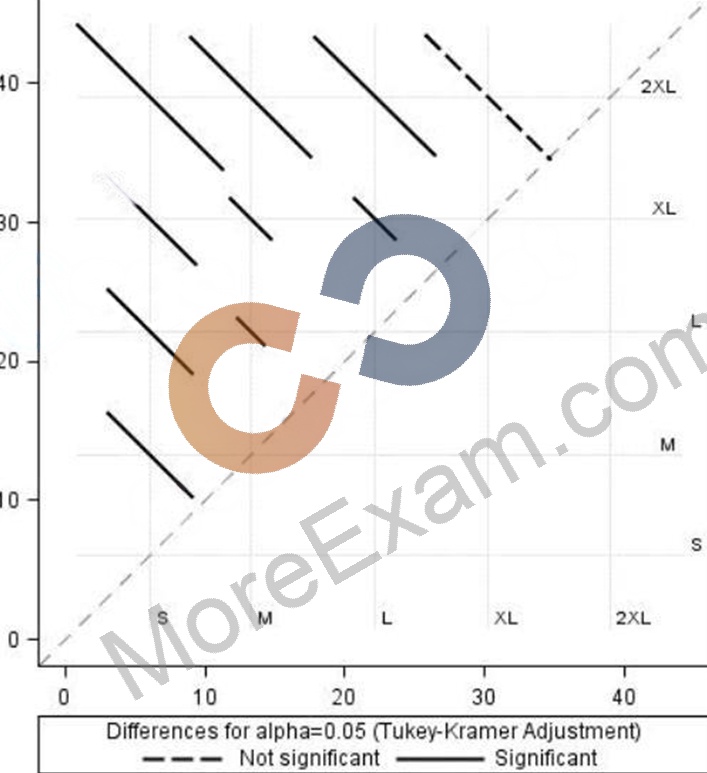
Question8: Refer to the exhibit.

Given alpha=0.02, which conclusion is justified regarding percentage of body fat, comparing small (S),
medium (M), and large (L) wrist sizes?

Question9: Refer to the lift chart:
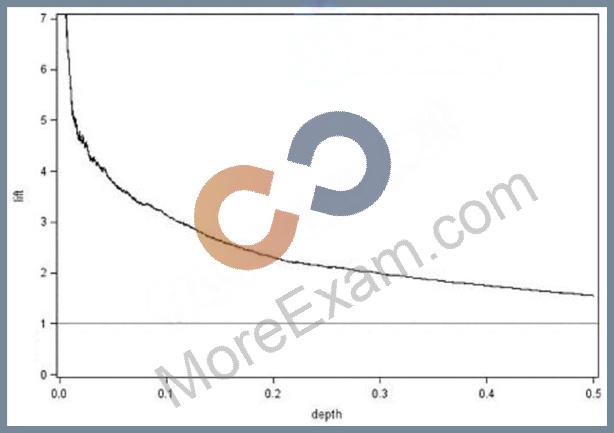
At a depth of 0.1, Lift = 3.14. What does this mean?
Question10: In order to perform honest assessment on a predictive model, what is an acceptable division between
training, validation, and testing data?

Question11: Screening for non-linearity in binary logistic regression can be achieved by visualizing:

Question12: Refer to the REG procedure output:

An analyst has selected this model as a champion because it shows better model fit than a competing
model with more predictors.
Which statistic justifies this rationale?

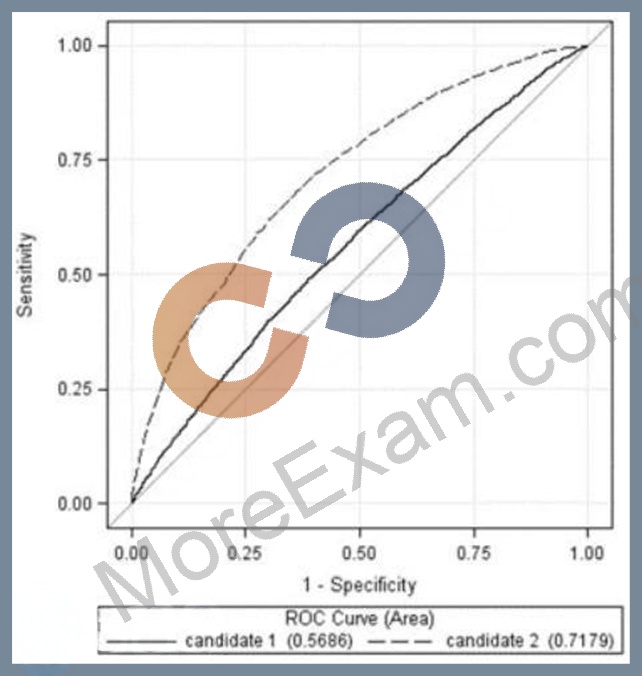
Question13: Refer to the exhibit:

Based upon the comparative ROC plot for two competing models, which is the champion model and why?

Question14: Which statistic, calculated from a validation sample, can help decide which model to use for prediction of a
binary target variable?

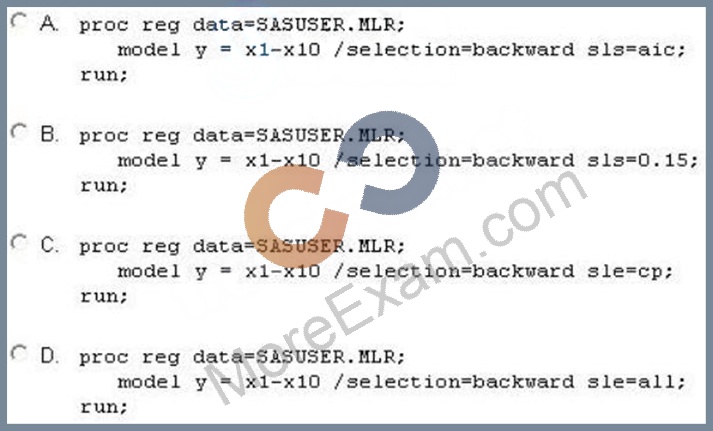
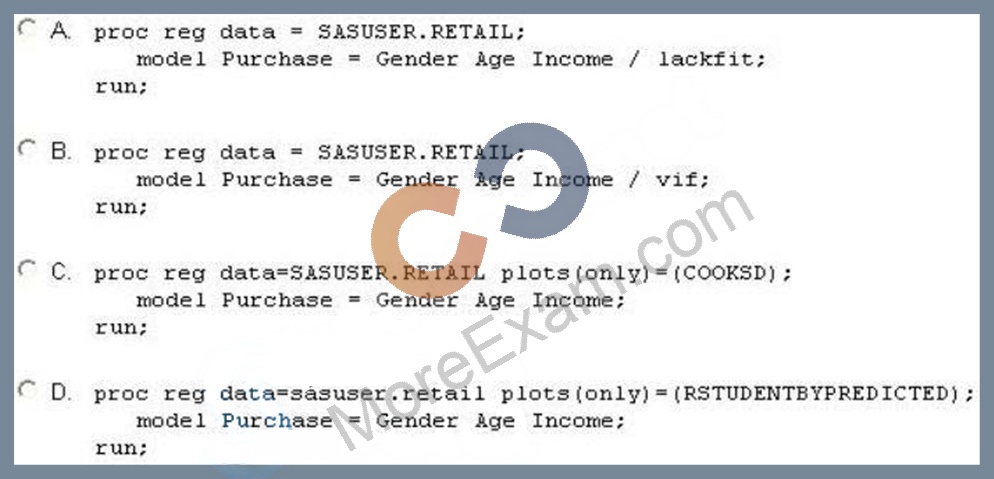
Question15: Which SAS program will correctly use backward elimination selection criterion within the REG procedure?

Question16: Which SAS program will detect collinearity in a multiple regression application?
Question17: What is the default method in the LOGISTIC procedure to handle observations with missing data?

Question18: There are missing values in the input variables for a regression application.
Which SAS procedure provides a viable solution?

Question19: Suppose training data are oversampled in the event group to make the number of events and non-events
roughly equal. A logistic regression is run and the probabilities are output to a data set NEW and given the
variable name PE. A decision rule considered is, "Classify data as an event if probability is greater than
0.5." Also the data set NEW contains a variable TG that indicates whether there is an event (1=Event, 0
No event).
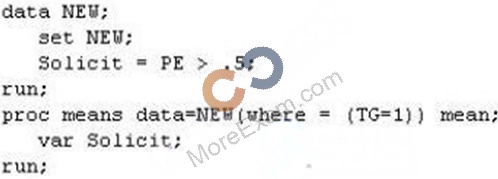
The following SAS program was used.

What does this program calculate?

Question20: The total modeling data has been split into training, validation, and test data. What is the best data to use
for model assessment?

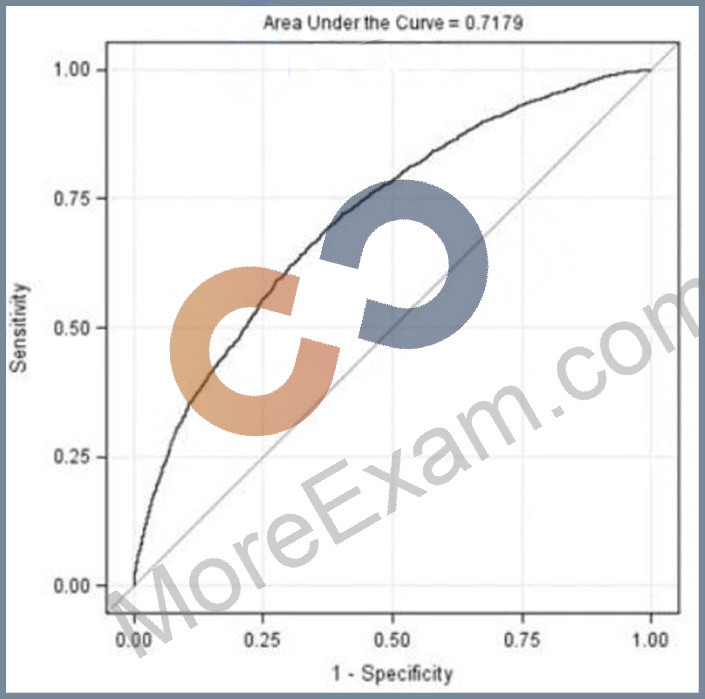
Question21: Refer to the ROC curve:

As you move along the curve, what changes?

Question22: Including redundant input variables in a regression model can:
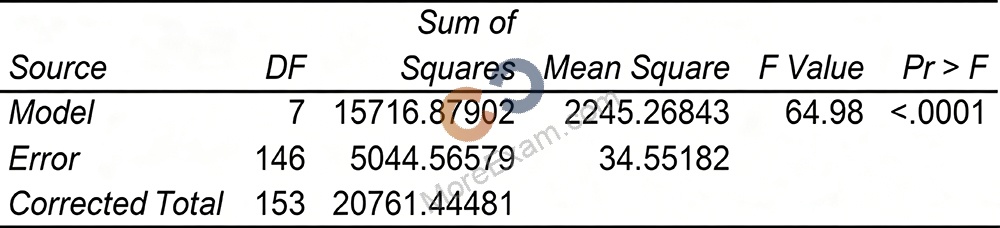
Question23: Customers were surveyed to assess their intent to purchase a product. An analyst divided the customers
into groups defined by the company's pre-assigned market segments and tested for difference in the
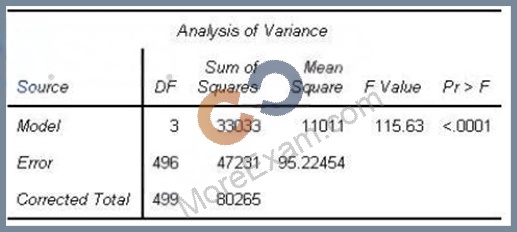
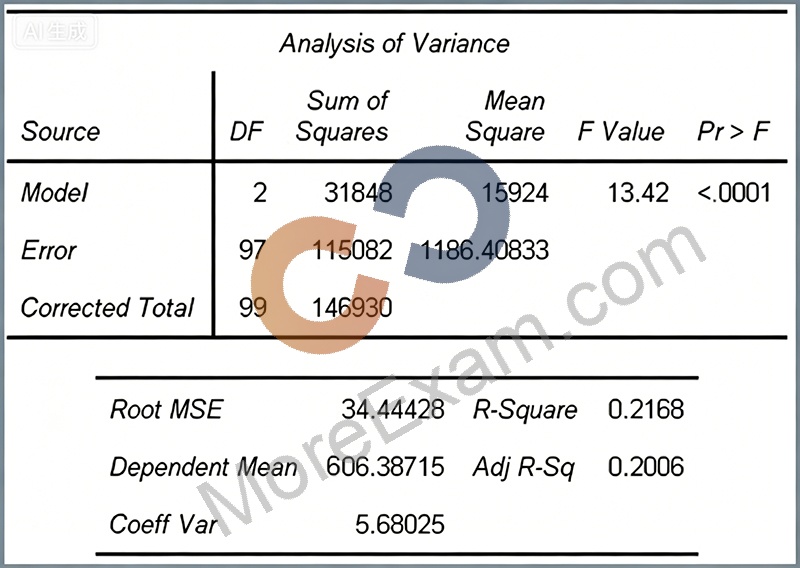
customers' average intent to purchase. The following is the output from the GLM procedure:

What percentage of customers' intent to purchase is explained by market segment?
Click the calculator button to display a calculator if needed.

Question24: One common approach for predicting rare events in the LOGISTIC procedure is to build a model that
disproportionately over-re presents those cases with an event occurring (e.g. a 50-50 event/non-event
split).
What problem does this present?

Question25: An analyst knows that the categorical predictor, storeId, is an important predictor of the target.
However, store_Id has too many levels to be a feasible predictor in the model. The analyst wants to
combine stores and treat them as members of the same class level.
What are the two most effective ways to address the problem? (Choose two.)

Question26: Consider scoring new observations in the SCORE procedure versus the SCORE statement in the
LOGISTIC procedure.
Which statement is true?

Question27: Refer to the REG procedure output:
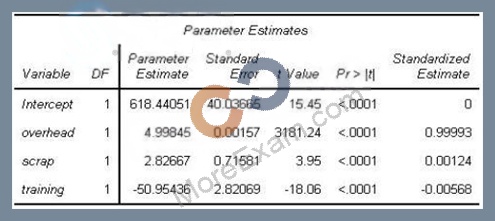
The Intercept estimate is interpreted as:
Question28: Which method is NOT an appropriate way to score new observations with a known target in a logistic
regression model?

Question29: A confusion matrix is created for data that were oversampled due to a rare target.
What values are not affected by this oversampling?

Question30: A non-contributing predictor variable (Pr > |t| =0.658) is added to an existing multiple linear regression
model.
What will be the result?

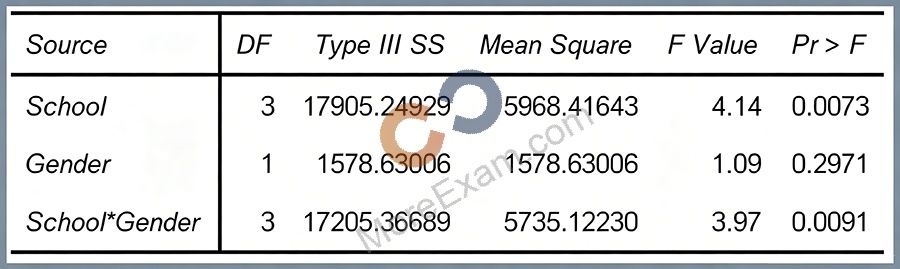
Question31: Given the following GLM procedure output:

Which statement is correct at an alpha level of 0.05?

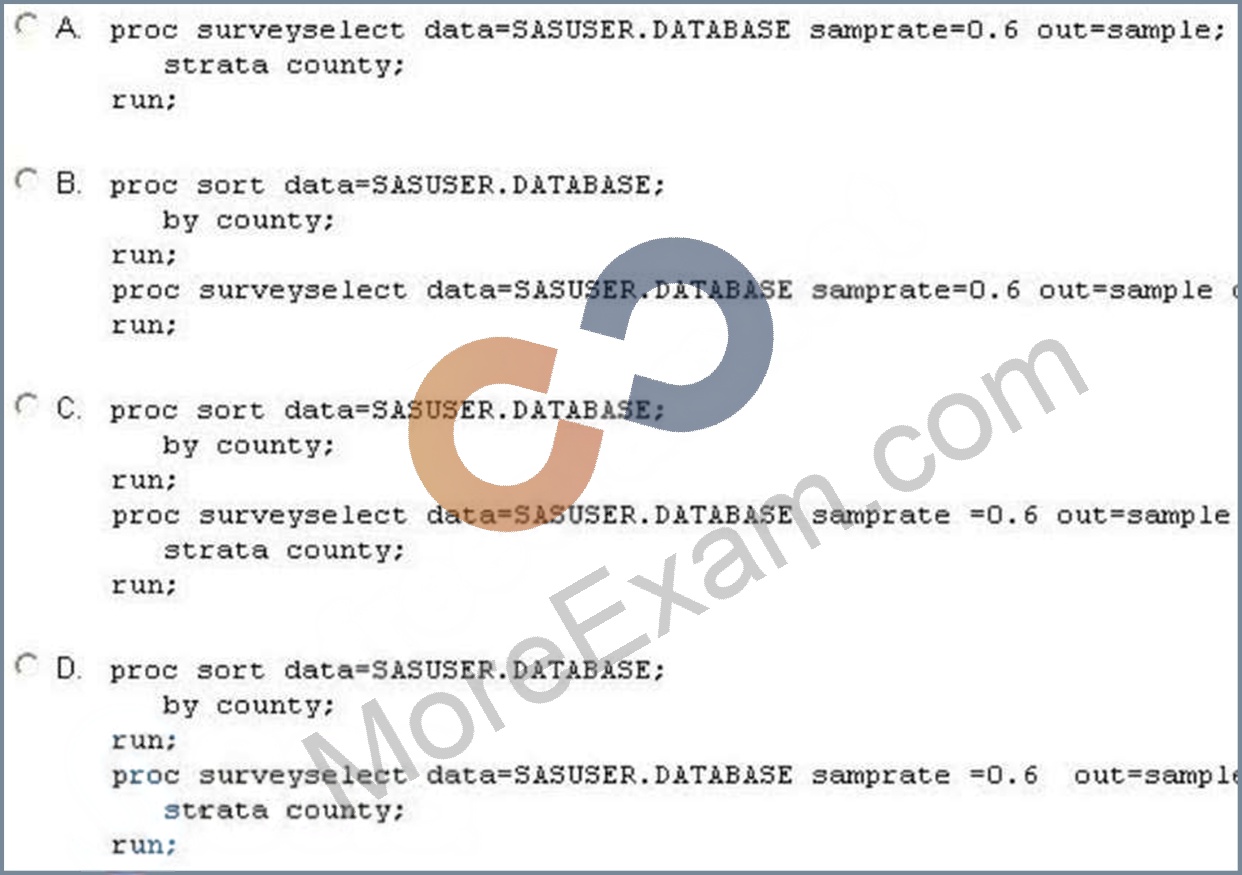
Question32: Which SAS program will divide the original data set into 60% training and 40% validation data sets,
stratified by county?

Question33: This question will ask you to provide a missing option.
Complete the following syntax to test the homogeneity of variance assumption in the GLM procedure:
Means Region / <insert option here> =levene;

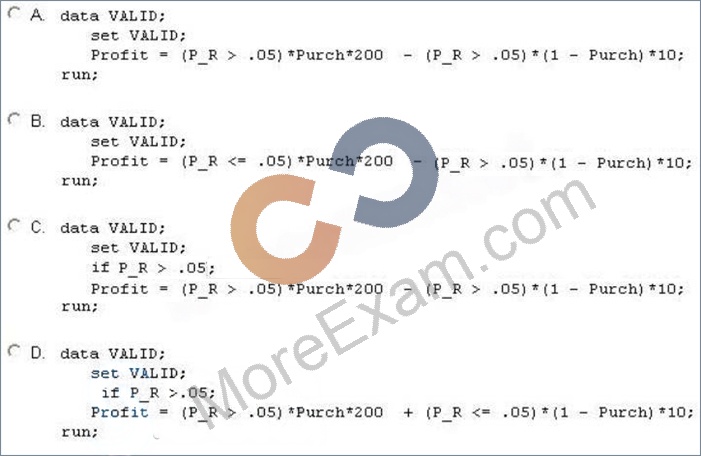
Question34: Assume a $10 cost for soliciting a non-responder and a $200 profit for soliciting a responder. The logistic
regression model gives a probability score named P_R on a SAS data set called VALID. The VALID data
set contains the responder variable Pinch, a 1/0 variable coded as 1 for responder. Customers will be
solicited when their probability score is more than 0.05.
Which SAS program computes the profit for each customer in the data set VALID?

Question35: A company has branch offices in eight regions. Customers within each region are classified as either "High
Value" or "Medium Value" and are coded using the variable name VALUE. In the last year, the total
amount of purchases per customer is used as the response variable.
Suppose there is a significant interaction between REGION and VALUE. What can you conclude?

Question36: An analyst generates a model using the LOGISTIC procedure. They are now interested in getting the
sensitivity and specificity statistics on a validation data set for a variety of cutoff values.
Which statement and option combination will generate these statistics?

Question37: Which of the following describes a concordant pair of observations in the LOGISTIC procedure?

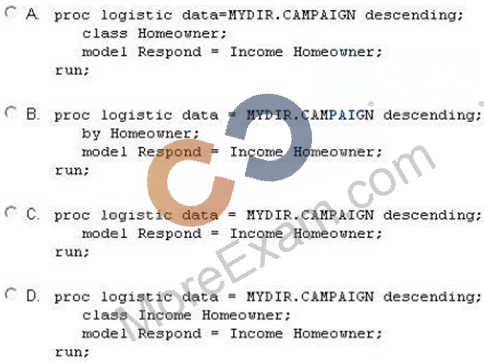
Question38: A marketing manager attempts to determine those customers most likely to purchase additional products
as the result of a nation-wide marketing campaign.
The manager possesses a historical dataset (CAMPAIGN) of a similar campaign from last year.
It has the following characteristics:
Target variable Respond (0, 1)

Continuous predictor Income

Categorical predictor Homeowner(Y, N)

Which SAS program performs this analysis?

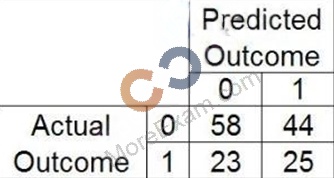
Question39: Refer to the confusion matrix:

Calculate the sensitivity. (0 - negative outcome, 1 - positive outcome)
Click the calculator button to display a calculator if needed.

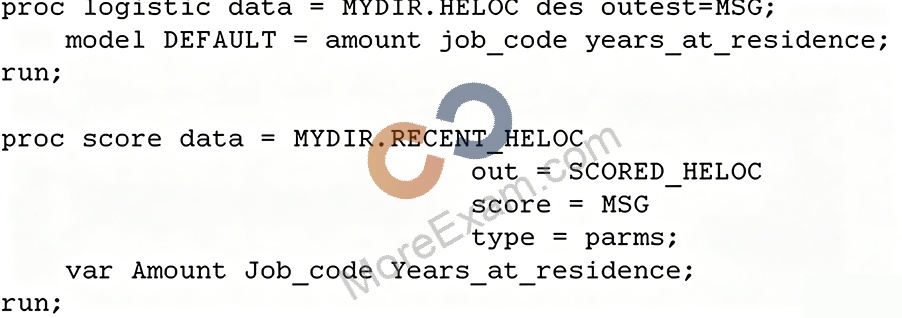
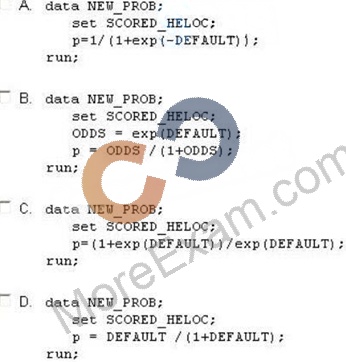
Question40: A financial services manager wants to assess the probability that certain clients will default on their Home
Equity Line of Credit (HELOC). A former employee left the code listed below.

The training data set is named HELOC, while a similar data set of more recent clients is named
RECENT_HELOC. Which SAS data steps will calculate the predicted probability of default on recent
clients? (Choose two.)

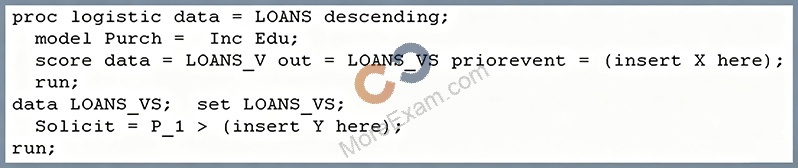
Question41: This question will ask you to provide missing code segments.
A logistic regression model was fit on a data set where 40% of the outcomes were events (TARGET=1)
and 60% were non-events (TARGET=0). The analyst knows that the population where the model will be
deployed has 5% events and 95% non-events. The analyst also knows that the company's profit margin for
correctly targeted events is nine times higher than the company's loss for incorrectly targeted non-event.
Given the following SAS program:

What X and Y values should be added to the program to correctly score the data?

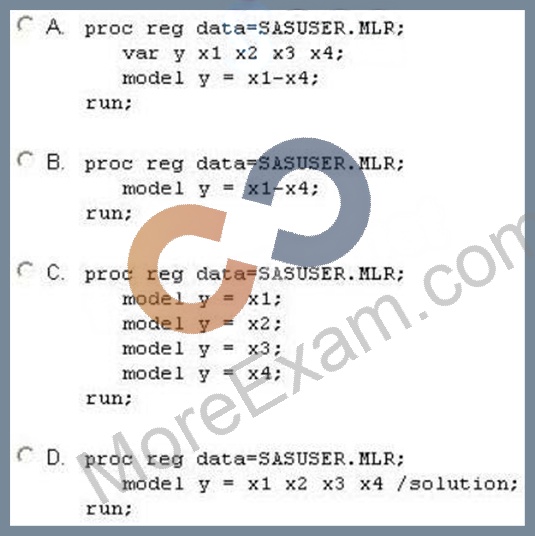
Question42: Identify the correct SAS program for fitting a multiple linear regression model with dependent variable (y)
and four predictor variables (x1-x4).

Question43: Refer to the lift chart:
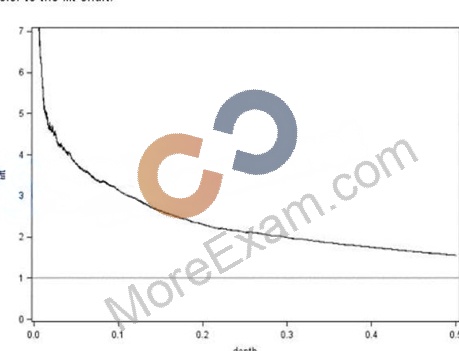
What does the reference line at lift = 1 corresponds to?

Question44: The question will ask you to provide a missing statement. Given the following SAS program:

Which SAS statement will complete the program to correctly score the data set NEW_DATA?

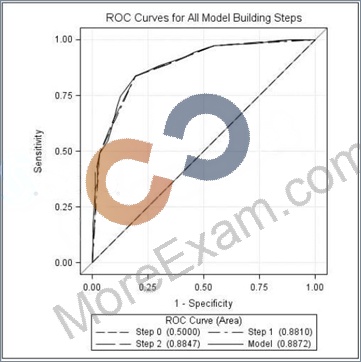
Question45: Refer to the exhibit:

An analyst examined logistic regression models for predicting whether a customer would make a
purchase. The ROC curve displayed summarizes the models. Using the selected model and the analyst's
decision rule, 25% of the customers who did not make a purchase are incorrectly classified as purchasers.
What can be concluded from the graph?

Question46: A predictive model uses a data set that has several variables with missing values.
What two problems can arise with this model? (Choose two.)

Question47: Refer to the exhibit:

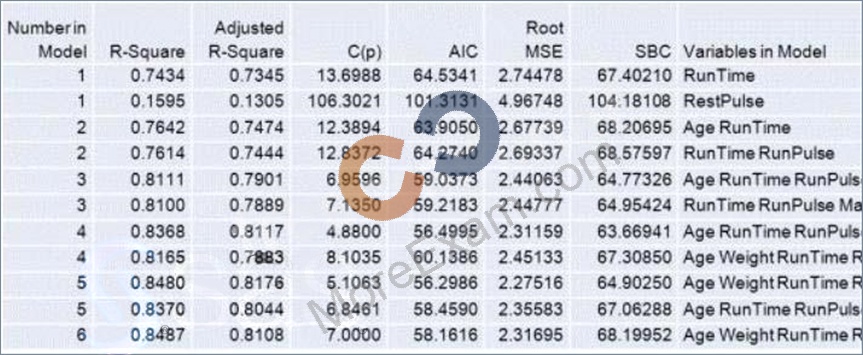
SAS output from the RSOUARE selection method, within the REG procedure, is shown. The top two
models in each subset are given.
Based on the AIC statistic, which model is the champion model?

Question48: Refer to the exhibit.

Based on the control plot, which conclusion is justified regarding the means of the response?

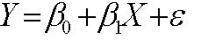
Question49: The standard form of a linear regression model is:

Which statement best summarizes the assumptions placed on the errors?

Question50: Given the following LOGISTIC procedure:

What is the difference between the datasets OUTFILEJ and OUTFILE_2?

Question51: What is a drawback to performing data cleansing (imputation, transformations, etc.) on raw data prior to
partitioning the data for honest assessment as opposed to performing the data cleansing after partitioning
the data?

Question52: SIMULATION
A linear model has the following characteristics:
*A dependent variable (y)
*One continuous variable (xl), including a quadratic term (x12)
*One categorical (d with 3 levels) predictor variable and an interaction term (d by x1)
How many parameters, including the intercept, are associated with this model?
Enter your numeric answer in the space below. Do not add leading or trailing spaces to your answer.

Question53: Refer to the REG procedure output:

Click on the calculator button to display a calculator if needed.

Question54: A linear model has the following characteristics:
A dependent variable (y)

Three continuous predictor variables (x1-x3)

One categorical predictor variable (c1 with 3 levels)

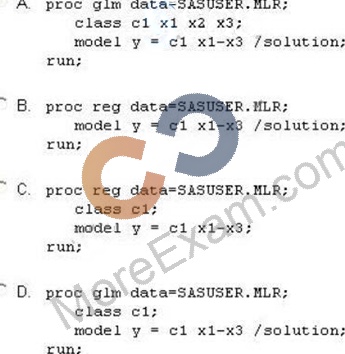
Which SAS program fits this model?

Question55: A marketing campaign will send brochures describing an expensive product to a set of customers. The
cost for mailing and production per customer is $50. The company makes $500 revenue for each sale.
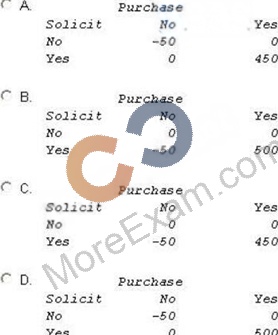
What is the profit matrix for a typical person in the population?

Question56: When mean imputation is performed on data after the data is partitioned for honest assessment, what is
the most appropriate method for handling the mean imputation?

Question57: In partitioning data for model assessment, which sampling methods are acceptable? (Choose two.)

Question58: Refer to the following odds ratio table:

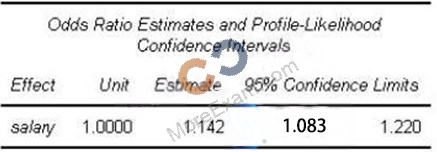
What is a correct interpretation of the estimate?

Question59: The selection criterion used in the forward selection method in the REG procedure is:

Question60: Select the equivalent LOGISTIC procedure model statements. (Choose two.)